TAIPEI, TAIWAN, September 1, 2026 — The World Innovation, Technology & Services Alliance (WITSA), a leading voice of the global technology industry, today released the WITSA Global AI Index 2026, a diagnostic measurement tool of national AI ecosystem development, at the WITSA Global AI Summit 2026.
Built on 83 indicators spanning 128 tracked economies and drawing on more than 30 independent sources — including the ITU, World Bank, OECD, UNESCO, WIPO, ILO, UNDP, IMF and UNCTAD, alongside publicly available data from national governments — the Index scores economies on their structural capacity to translate AI innovation and investment into lasting economic and social value.
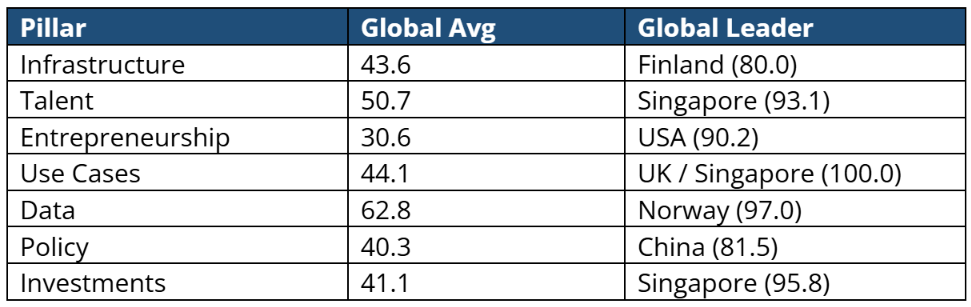
The Index measures what economies have actually built, not what they have planned or announced. It scores economies across seven pillars — AI Infrastructure, AI Talent, AI Entrepreneurship, AI Use Cases, Data, Policy and AI Investments — and was validated by an independent panel of 22 experts spanning 18 economies and six global regions, all free of AI vendor ties or conflicts of interest.
The Index deliberately measures how deeply AI capability is embedded in an economy, not how much exists in absolute terms. Scoring relative to population allows a smaller economy that has built real depth to be seen fairly alongside far larger ones. For contrast, WITSA also publishes an absolute-scale blended view, combining an economy's primary score with its absolute-scale score using a geometric mean.
HEADLINE FINDINGS
VOICES FROM WITSA
According to WITSA Chairman, Dato’ Dr Sean Seah, “When WITSA’s 80 member economies came together to develop a transformational diagnostic AI Ecosystem Development Index, the question was not simply, ‘How do we score countries?’ It was, ‘How do we give governments around the world a clear, credible picture of what their AI ecosystem looks like today—and what it needs to become tomorrow?’
“The WITSA Global AI Index provides that picture. Across 128 economies, our 22-member international Expert Panel has validated a methodology designed to measure not simply what governments intend to build, but what their AI ecosystems have actually developed and achieved.”
“Combined with WITSA’s Global AI Ecosystem Network (GAIN), the Index becomes more than a benchmark. It becomes a strategic map—helping governments, businesses, investors and other stakeholders understand where they stand, identify the gaps, and chart the journey toward a stronger, more inclusive and sustainable AI future.”
WITSA Deputy Chairman and Chairman, WITSA AI Task Force, Robert Janssen echoed, “WITSA has been mapping the impact of AI for years, through our policy papers and through the AI events that are now part of our portfolio. This work is the next step in that commitment. The AI Task Force has worked on the architecture of AI ecosystem measurement because the industry needed an instrument the technology sector itself could stand behind, one built on methodological rigor, not narrative convenience. The result is a 7-pillar, 16-sub-pillar, 83-indicator framework that is OECD/JRC-compliant and designed to be longitudinal, validated by a 22-member Expert Panel. The framework and GAIN are designed together. One without the other is incomplete.”
Edward Brzytwa, Chairman, WITSA Global Policy Action Committee, “The WITSA Global AI Index gives policymakers something they have never had before: a government-usable, independently validated, 128-economy dataset that measures AI ecosystem development — not AI spending, not AI strategy declarations, but the structural conditions that determine whether policy intentions convert into economic outcomes. WITSA's Global Policy Action Committee is committed to embedding this data in G20 digital economy working groups, ASEAN's digital economy framework, the AU's digital transformation strategy, and development finance lending criteria.”
WITSA CEO, Dato’ Dan E Khoo highlighted, “WITSA did not set out to build another ranking. WITSA set out to answer a harder question, honestly, for the first time — has this economy actually built the structural conditions for AI to generate value that compounds, year over year, for its stakeholders? That question is why this Index measures AI Ecosystem Development and not readiness. But a diagnosis that stops at diagnosis is a wasted opportunity. That is why, from the very first architecture sessions, WITSA insisted that this Index could never stand alone. It had to be the as-is half of something larger — a transformation architecture that carries every economy from where it stands today to where it has the ambition to be. That is WITSA GAIN. The Index tells you the truth about today. GAIN is how WITSA helps you act on it tomorrow. So this is not a call to read a report. It is a call to action. WITSA built this Index to remove every excuse for inaction. What every economy does with that honesty is now the story WITSA GAIN exists to help them write.”
WITSA’s VP of Global Public Policy, Anders Halvorsen added, “The WITSA Global AI Index is the product of a rigorous, multi-year data architecture effort — 83 indicators, 16 sub-pillars, 7 pillars, across 128 economies, calibrated against an OECD/JRC-compliant composite indicator methodology and reviewed by 22 independent international experts. The methodology is published in full. Every indicator has a documented source. Every imputed value is flagged. And every economy has the right to contest a specific indicator value through the formal Data Review Process run by the Secretariat's Data Collection team. That transparency is not incidental — it is the mechanism that makes this Index credible and contestable in equal measure.”
FROM DIAGNOSIS TO ACTION: WITSA GAIN
Alongside the Index, WITSA also unveiled the WITSA Global AI Ecosystem Network (WITSA GAIN), a four-tier pathway designed to help every economy act on its results, regardless of where it starts. The pathway begins with a free GAIN Membership tier, offering the flagship report and a microsite scorecard to all WITSA members. GAIN Pathway follows with a briefing on an economy's Index position. The Economy Report tier delivers a full report built on all 83 indicators, including gap analysis and peer comparisons. At the top, the Premium and Founding Hub tier — with Hub access limited to three economies and Premium available to all others — offers advisory support, roadmapping, summit hosting and a three-phased milestone plan. The four tiers are designed to match differing needs and budgets, each delivering added value to membership.
WITSA GAIN is designed to serve governments, industry, academia and investors alike: governments receive a validated diagnosis and a clear starting priority rather than a spreadsheet to interpret alone; industry gains a credible external benchmark for where the market actually stands; academia gains a rigorous, longitudinal dataset; and investors gain an independent signal for where capital is structurally positioned to work.
Every scored economy receives its own three-pillar improvement target, computed by the same published formula for all 105, with nothing negotiated and nothing discretionary. Those targets show how much of the work is shared: AI Entrepreneurship is one of the three weakest pillars for 89 of the 105 scored economies. They also show how hard it is — these are structural gaps in company formation, workforce depth and governance capacity that take years of sustained effort to close, rather than a single budget cycle. WITSA GAIN is the vehicle WITSA is putting behind that effort, economy by economy, measured against the same Index each year.
CALL TO ACTION
WITSA invites governments, ministries, regulators and national tech associations to engage directly with the Index and with WITSA GAIN to accelerate their own AI ecosystem development. Economies interested in a briefing on their Index position, a full Economy Report, or Founding Hub partnership are invited to connect with WITSA at witsa.org or through their national WITSA member association.
Economies seeking greater depth can also engage GAIN Premium, which includes a national AI maturity assessment, a national AI action plan, and national AI strategic and scenario planning.
ABOUT THE WITSA GLOBAL AI INDEX
The WITSA Global AI Index 2026 measures the diagnostics of the AI ecosystem across 128 tracked economies, scoring 103 on a composite Ecosystem Development Score built from 83 indicators across seven pillars: AI Infrastructure, AI Talent, AI Entrepreneurship, AI Use Cases, Data, Policy and AI Investments. Data is drawn from more than 30 independent sources, including the ITU, World Bank, OECD, UNESCO, WIPO, ILO, IEA, IRENA, IMF, UNCTAD, UNDP, UN DESA, FAO, ICAO, OpenAlex, Epoch AI, the TOP500 list, Open Data Watch, Oxford Insights, GitHub, Stack Overflow, StartupBlink, the International Federation of Robotics, GSMA Intelligence, Ipsos, Gallup, the Cloud Security Alliance and F6S, alongside submissions from national ministries, regulators and statistical offices via WITSA's National Ecosystem Steward network. The dataset was frozen on August 14, 2026, and the methodology, indicator set and weights were validated by an independent 22-member expert panel spanning 18 economies and all six global regions prior to scoring calculation. Full sourcing and methodology appear in Appendices B and D of the flagship report. Scores are computed on a per-capita basis; an Absolute-Scale Blended View is published in full as Appendix G.
About WITSA
The World Innovation, Technology and Services Alliance (WITSA) is a global consortium of tech industry associations from 80 countries and economies. WITSA is committed to driving innovation, advancing economic growth, and fostering international trade and investment in the tech industry. Through its leadership and advocacy, WITSA strengthens its members' national industry associations and connects them to a vast network of global professionals and partners.
WITSA’s catalytic platforms include the WITSA World Cup, the WITSA Global AI Ecosystem Network and the World Congress on Innovation & Technology (WCIT), recognized as the premier international tech industry platform.
The WITSA Global AI Ecosystem Network unites a global network of AI hubs to drive advancements in artificial intelligence, while the WITSA World Cup fosters competition among the best scaleups, celebrating innovation and tech entrepreneurship at a global stage.
WITSA continues to catalyze industry collaboration, pushing the frontiers of digital transformation and innovation. By uniting members from diverse regions across six continents, WITSA creates a platform for collaboration, knowledge exchange, and collective advocacy on critical industry issues. Through these efforts, WITSA plays a pivotal role in shaping the future of the global digital economy.
Contact person:
WITSA Global AI Index: Anders Halvorsen, VP Global Public Policy: ahalvorsen@witsa.org
WITSA Catalytic Platforms, Azlina Ishak, Marcom Director: azlina@witsa.org


