That result reframes what a national AI strategy is for. Most strategies of the past three years have concentrated on the things a government can procure or legislate: compute, data rulebooks, national strategies, training programs. The Index finds that those are the capabilities converging fastest and differentiating least. What separates economies is the harder thing, the formation of companies that turn research and capital into products, and that is precisely what no ministry can buy directly.
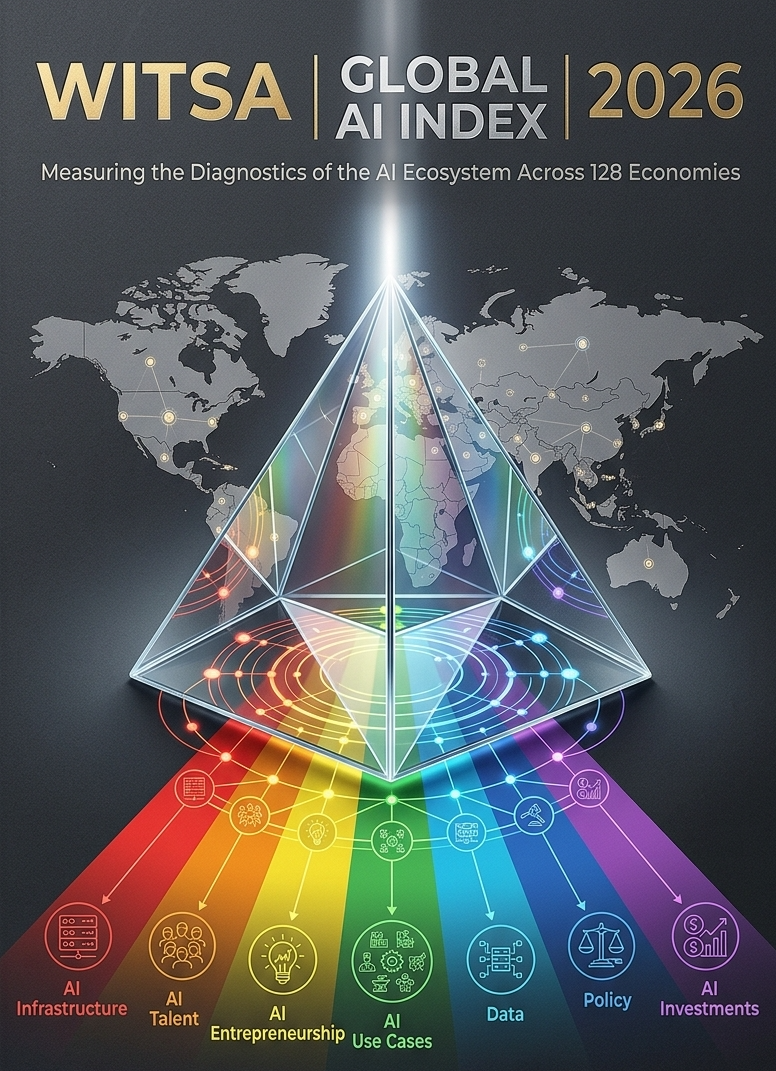
This summary sets out eleven numbered findings: nine results from the measurement itself, a tenth on the limits a reader should hold in mind while using it, and an eleventh on what the aggregate of 105 measured positions implies for the world’s AI development agenda. Each economy’s seven pillar scores combine into a single composite, the Ecosystem Development Score, or EDS, on a 0 to 100 scale, and every composite comparison in this report runs on it. The evidence sits in the chapters behind this summary: seven pillar narratives, six regional profiles, and roughly 450 pages of individual economy profiles. Every Index figure here is computed from the same dataset those chapters use, closed on 14 August 2026, and can be checked against it; external figures are attributed where they appear and listed at the end.
Each point is one of the Index’s seven pillars. The horizontal axis is the pillar’s global average score; the vertical axis is how strongly an economy’s score on that pillar tracks its standing on the other six. The relationship is strongly inverse, with a rank correlation of −0.86.
Visit: index.witsa.org/2026/


